
Last updated: August 14, 2026 | Author: Dr. Amanda Myers, DC, MS
A tendon that has hurt for eight months is not injured any more. It is stuck. The inflammation ended long ago and the repair process quietly stopped without finishing the job.
That is the specific problem shockwave therapy for tendon pain is built to solve — and it is why rest, which works so well for a fresh injury, does nothing here.
What does shockwave therapy do for tendon pain?
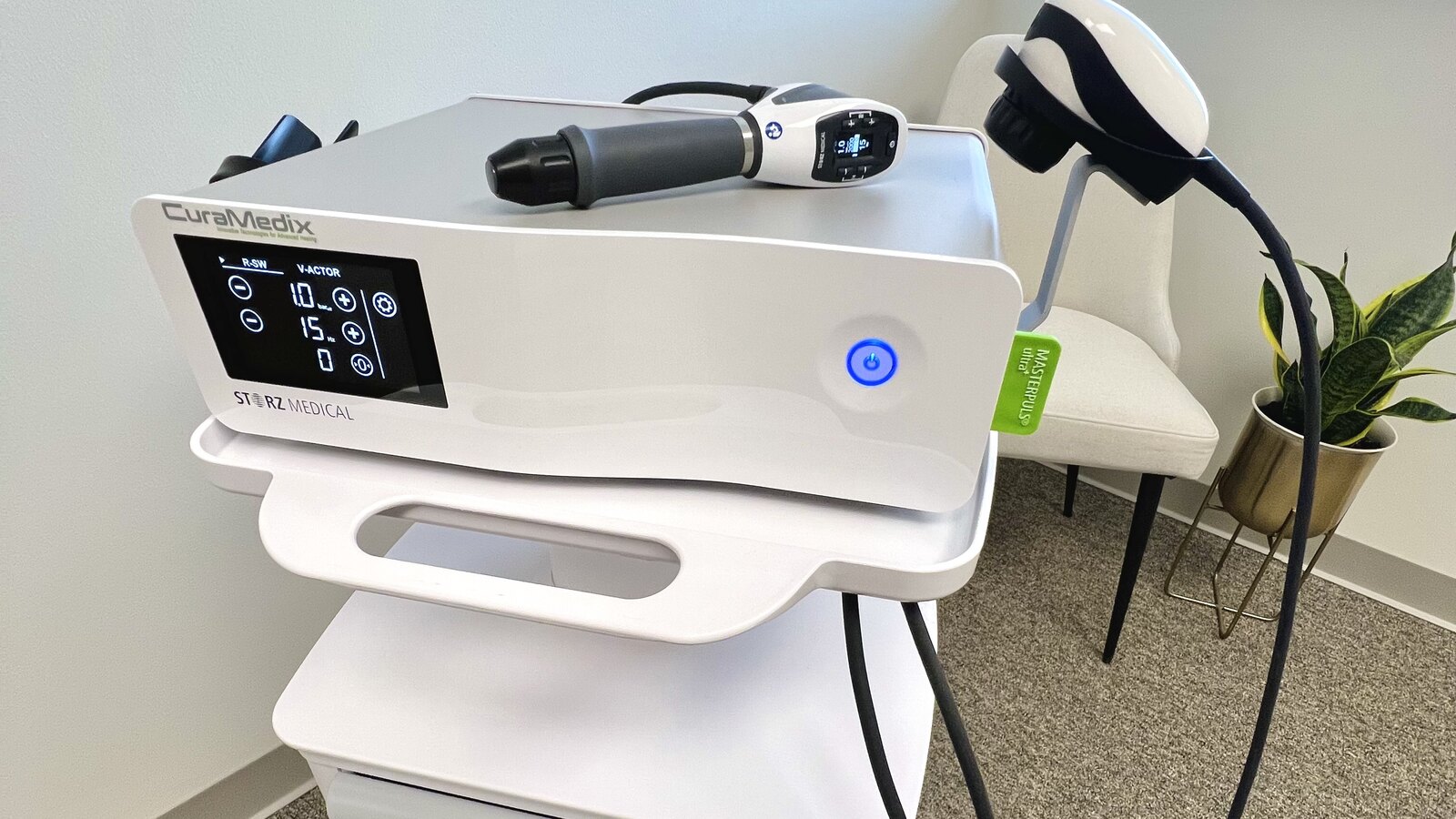
Shockwave delivers high-energy acoustic pressure waves into a degenerated tendon to restart a repair process that stalled. It provokes new blood vessel formation and collagen turnover in tissue that had gone dormant. It is not pain relief — it is a controlled stimulus that makes the tendon rebuild.
Why does some tendon pain never fully resolve?
Most people are told they have tendinitis, which means inflammation. After the first few weeks that is usually wrong. What you have is tendinopathy: the collagen inside the tendon has become disorganised, the blood supply has dropped off, and the tissue has settled into a state where it hurts but is not actively healing.
This is why the standard advice fails. Rest removes the load that would stimulate repair. Anti-inflammatories target inflammation that is no longer there. A cortisone injection reduces pain for six weeks and, in several tendons, weakens the tissue further.
The tendon does not need protecting. It needs provoking.
What does shockwave actually change inside the tissue?
- New blood supply. Acoustic waves trigger neovascularisation — new capillaries into a region that had become under-perfused.
- Collagen turnover. The disorganised fibres get broken down and laid back down along lines of stress, provided you load the tendon properly between sessions.
- Reduced pain signalling. Local nerve endings that had become sensitised are down-regulated, which is why pain often drops before the tissue has finished remodelling.
- Breaking up calcification. In calcific tendinopathy, particularly the shoulder, the waves can fragment the deposit itself.
Shockwave therapy vs the alternatives for tendon pain
| Option | What it targets | Honest limitation |
|---|---|---|
| Rest | Acute inflammation | Removes the load that stimulates repair. Deconditions the tendon. |
| Anti-inflammatories | Inflammation and pain | Chronic tendinopathy is not primarily inflammatory. |
| Cortisone injection | Pain, fast | Relief typically 6–12 weeks; repeated injections can weaken tendon tissue. |
| Loading rehab alone | Collagen remodelling | Works, but slowly, and often too painful to progress at first. |
| Shockwave therapy for tendon pain | Restarting the repair response | Needs 3–6 sessions and only works paired with progressive loading. |
| Surgery | Removing degenerated tissue | Long recovery. Reasonable when conservative care has genuinely failed. |
Which tendons respond best?
The ones we treat most often, and the ones with the strongest track record:
- Plantar fascia and heel pain — frequently the reason plantar fasciitis keeps coming back after months of stretching.
- Achilles tendinopathy — mid-portion responds better than insertional.
- Tennis and golfer’s elbow — lateral and medial epicondylalgia.
- Patellar tendinopathy — jumper’s knee.
- Gluteal tendinopathy — the real cause of a lot of “hip bursitis”.
- Calcific shoulder tendinopathy — where a visible deposit is driving it.
Court and racquet sports load several of these hard, which is why tendon problems show up so often in our pickleball injuries guide.
What does a session involve?
Gel on the skin, a handpiece over the tender area, and 5 to 10 minutes of rhythmic pulses per region. It is uncomfortable rather than painful, and intensity is set to what you tolerate. Mild soreness for a day or two afterward is normal and is part of the response.
You are not sedated, you drive yourself home, and you carry on with your day. Detail on course length and spacing is in how many shockwave therapy sessions you need, and service specifics live on our shockwave therapy page.
Who is this built for, and who is it not?
Good fit: tendon pain running longer than three months, a clear diagnosis, previous rest and anti-inflammatories that did not hold, and a willingness to do progressive loading between sessions.
Not a fit: an acute injury with swelling and lost function, pregnancy, bleeding disorders or anticoagulant therapy, active infection or open wound over the area, a tumour or growth plate in the treatment field, or a nerve or circulatory condition affecting the region. We screen for all of it before session one.
Why it only works alongside the rest of the plan
Shockwave restarts repair. Loading rehab tells the new collagen what to be strong for. Without the second part, you are stimulating tissue and giving it no instruction.
And neither addresses why the tendon was overloaded. If your ankle lost motion, the Achilles absorbs it. If your hip will not rotate, the knee pivots. That mechanical layer is what stops this becoming an annual event — the same reason back pain keeps coming back when only the painful part gets treated. Where guarding is limiting progress we add massage therapy and chiropractic care, and where pain is the limiter, acupuncture.
We see patients from Lombard, Glen Ellyn, Wheaton, Villa Park, Elmhurst and across DuPage County.
Shockwave therapy for tendon pain FAQ
How long until shockwave therapy works on tendon pain?
Most people notice a measurable change after the second or third session — usually better load tolerance or faster recovery after activity rather than lower peak pain. Full tissue remodelling continues for weeks after the course finishes.
Is shockwave therapy better than a cortisone injection for tendon pain?
They do opposite things. Cortisone suppresses pain quickly and can weaken tendon tissue with repeated use. Shockwave provokes repair and takes longer to feel. For chronic tendinopathy, the repair route addresses the actual state of the tissue.
Does shockwave therapy hurt?
It is uncomfortable during treatment — a deep thudding that intensifies over the tender spot — and mildly sore for 24 to 48 hours after. It should not stop you doing your day.
Can I run or train during a course of shockwave therapy?
Usually yes, with the load managed. Avoid heavy loading of the treated tendon for about 48 hours after each session, then continue the progressive plan. Complete rest works against the treatment.
What is the difference between tendinitis and tendinopathy?
Tendinitis is genuine inflammation, typically in the first few weeks. Tendinopathy is degeneration of the collagen without much inflammation, which is what most long-standing tendon pain actually is — and why anti-inflammatories stop helping.
Will the tendon pain come back after shockwave therapy?
It can, if the reason the tendon was overloaded is never addressed. That is why the mechanical assessment and the loading rehab are part of the plan rather than optional extras.
Book your New Patient Discovery Assessment
If a tendon has hurt for months and rest has not touched it, you do not have an inflammation problem. Let’s get to the root of it. Book your New Patient Discovery Assessment at True Health Chiropractic and Acupuncture in Lombard.
7 Responses