You have had plantar fasciitis for over a year. Or tennis elbow that will not quit. Or patellar tendinitis that flares every season. You have done the stretches. You have taken the anti-inflammatories. You have iced and rested and tried new shoes and modified your training. The pain keeps coming back. Generic rehab is not working. Cortisone gave you a few weeks of relief and now you are back where you started.
Shockwave therapy is the next step. It is research-backed for exactly this situation — chronic soft tissue injuries that have stopped responding to traditional care. It is non-invasive. No needles, no medication, no downtime. Most patients see significant improvement within four to six sessions.
What shockwave therapy actually is
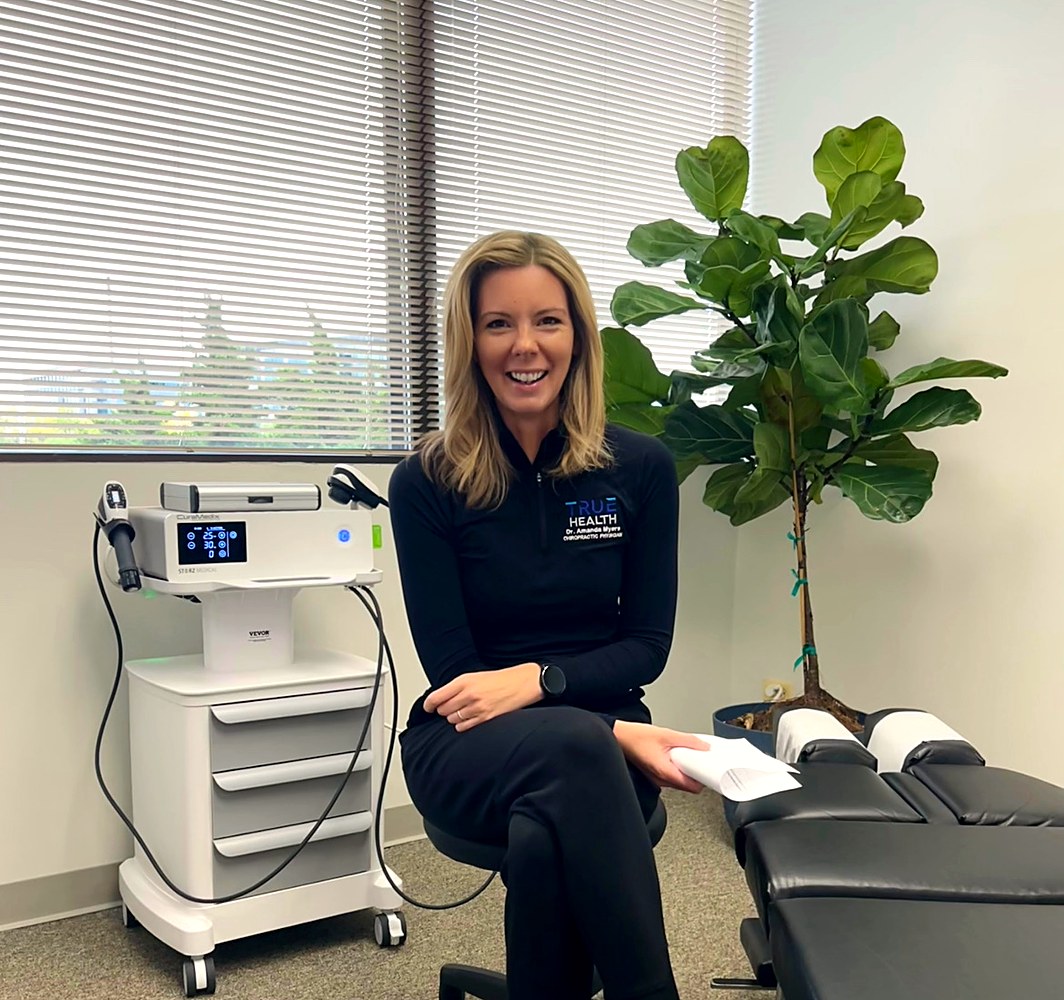
Shockwave therapy — technically called Extracorporeal Pulse Activation Technology (EPAT) — uses acoustic pressure waves to stimulate healing in chronic soft tissue injuries. The device is applied directly to the affected tissue. Each session takes about ten to fifteen minutes.
The mechanism: the pressure waves create a controlled micro-trauma to the affected tissue, which triggers the body’s natural healing cascade. New blood vessels form. Collagen reorganizes. The tissue gets the stimulus to actually heal rather than stay stuck in chronic inflammation.
Shockwave is FDA-cleared and has strong research support across multiple chronic soft tissue conditions. It is considered one of the most effective non-invasive treatments for tendinopathies and fasciopathies that have failed conservative care.
Conditions we treat with shockwave therapy
At True Health we use shockwave therapy primarily for chronic soft tissue conditions:
- Plantar fasciitis — particularly chronic cases (>3 months) that have failed stretching, inserts, and other treatment
- Achilles tendinopathy — both insertional and mid-portion Achilles problems
- Patellar tendinopathy (jumper knee) — chronic pain just below the kneecap
- Tennis elbow (lateral epicondylitis) — pain on the outside of the elbow
- Golfer elbow (medial epicondylitis) — pain on the inside of the elbow
- Rotator cuff tendinopathy — chronic shoulder tendon problems
- Hip and gluteal tendinopathy — pain over the outside of the hip
- Trigger points and chronic muscle tension — when manual work has not resolved the issue
Shockwave is generally best suited for chronic cases — typically issues that have persisted longer than three months and have not responded to rest, stretching, traditional rehab, or anti-inflammatory medication.
What to expect during a shockwave session
The session itself takes about ten to fifteen minutes per treatment area. A typical protocol is four to six sessions spaced one week apart. The procedure:
- Assessment. We confirm shockwave is appropriate for your specific condition and identify the precise treatment area.
- Gel application. A conductive gel is applied to the skin where the device will be positioned.
- Treatment. The shockwave device is held against the affected tissue. You will feel a strong rhythmic tapping sensation. The intensity is adjusted to what you can tolerate.
- Post-treatment. Some mild soreness afterward is normal — similar to the day after a workout. You can return to normal activity immediately. No restrictions on driving, working, or exercise.
Most patients describe the treatment as uncomfortable but tolerable. The improvement typically builds over the course of the treatment series and continues for several weeks after the final session.
When shockwave is the right answer — and when it is not
Shockwave works well for chronic tendinopathies, fasciopathies, and certain soft tissue conditions that have failed traditional care. It is not the right answer for:
- Acute injuries — usually better addressed with standard initial care first
- Conditions that have not yet been evaluated for cause — we always identify why the tissue failed before just treating it
- Conditions caused primarily by joint dysfunction — those need joint-focused treatment first
- Pregnancy, certain blood-clotting disorders, active infection in the treatment area, or treatment over the lungs, growth plates in children, or certain cancers
At your Discovery Assessment we determine whether shockwave is appropriate for your specific case. If it is not the right tool, we will tell you and recommend what is.
Common questions about shockwave therapy
Does shockwave therapy actually work?
Yes — for the right conditions. Shockwave therapy has strong research support specifically for chronic tendinopathies (Achilles, patellar, rotator cuff, elbow) and plantar fasciitis. Multiple studies show significant improvement in pain and function in cases that had failed traditional treatment. It is FDA-cleared and widely used in sports medicine and physical therapy. Like any treatment, it works best when matched to the right condition — which is why we assess first.
How many shockwave sessions will I need?
Most patients complete four to six sessions spaced one week apart. Some chronic cases need a few additional sessions. We evaluate progress throughout the series and adjust the protocol based on how you are responding. Most patients see meaningful improvement during the treatment series and continued improvement in the weeks after the final session.
Does shockwave therapy hurt?
Most patients describe it as uncomfortable but tolerable — a strong rhythmic tapping or thumping sensation. The intensity is adjusted to what you can handle. Some mild soreness afterward is normal and resolves within a day. There is no needles, no anesthesia required, no downtime. You can walk out and return to normal activity immediately.
Is shockwave the same as TENS or ultrasound?
No — different technology entirely. TENS uses electrical stimulation for pain control. Therapeutic ultrasound uses gentle sound waves for tissue warming. Shockwave (EPAT) uses high-energy acoustic pressure waves to trigger a structural healing response in the tissue. The pressure waves penetrate deeper and produce stronger biological effects than ultrasound. Shockwave is specifically designed to stimulate healing in chronic tissue that has stopped healing on its own.
Will my insurance cover shockwave therapy?
Coverage varies by insurance plan. Some plans cover shockwave for specific conditions. Many plans do not. We verify your specific coverage and tell you upfront what is covered and what is self-pay. HSA and FSA payments are accepted. For self-pay patients, the investment in a shockwave protocol is typically much less than ongoing treatment, injections, or surgery for the same condition.
Can shockwave help if I have already had cortisone injections?
Yes — and many of our shockwave patients have. Cortisone provides short-term symptom relief but does not address the underlying tissue dysfunction, and repeated injections can actually weaken the tissue. Shockwave addresses the underlying cause by stimulating real healing. Many patients who have had multiple cortisone injections find shockwave gives them the lasting improvement injections never provided.
How is shockwave different from regular chiropractic or massage?
Shockwave is a specific modality for treating chronic soft tissue dysfunction at the cellular level. Chiropractic addresses joint motion. Massage addresses muscle tension and circulation. Shockwave triggers a healing cascade in tendon, fascia, and other soft tissues that have failed to heal on their own. They serve different purposes and often work best together as part of a coordinated plan.
Will I need to stop training during shockwave treatment?
Usually no — most patients continue training with modifications. The goal is to keep you moving in ways that support healing while shockwave addresses the underlying tissue problem. We give every shockwave patient specific guidance on what is okay to do during the treatment series, what to modify, and what to avoid. Complete activity shutdown is rarely necessary.
Shockwave therapy across DuPage County
- Shockwave therapy for Lombard patients
- Shockwave therapy for Wheaton patients
- Shockwave therapy for Glen Ellyn patients
- Shockwave therapy for Downers Grove patients
- Shockwave therapy for Elmhurst patients
- Shockwave therapy for Naperville patients
- Shockwave therapy for Oak Brook patients
- Shockwave therapy for Villa Park patients
- Shockwave therapy for Addison patients
Conditions we commonly treat with shockwave
- Plantar fasciitis
- Patellar tendinopathy (jumper knee)
- Rotator cuff tendinopathy
- Sports injuries — tendinopathies of all kinds
See if shockwave is the right answer for your condition.
Book a Discovery Assessment. We will evaluate your case, tell you honestly whether shockwave is the right tool, and build a plan from there.
Book Your Discovery Assessment
Or call: (630) 796-2083