
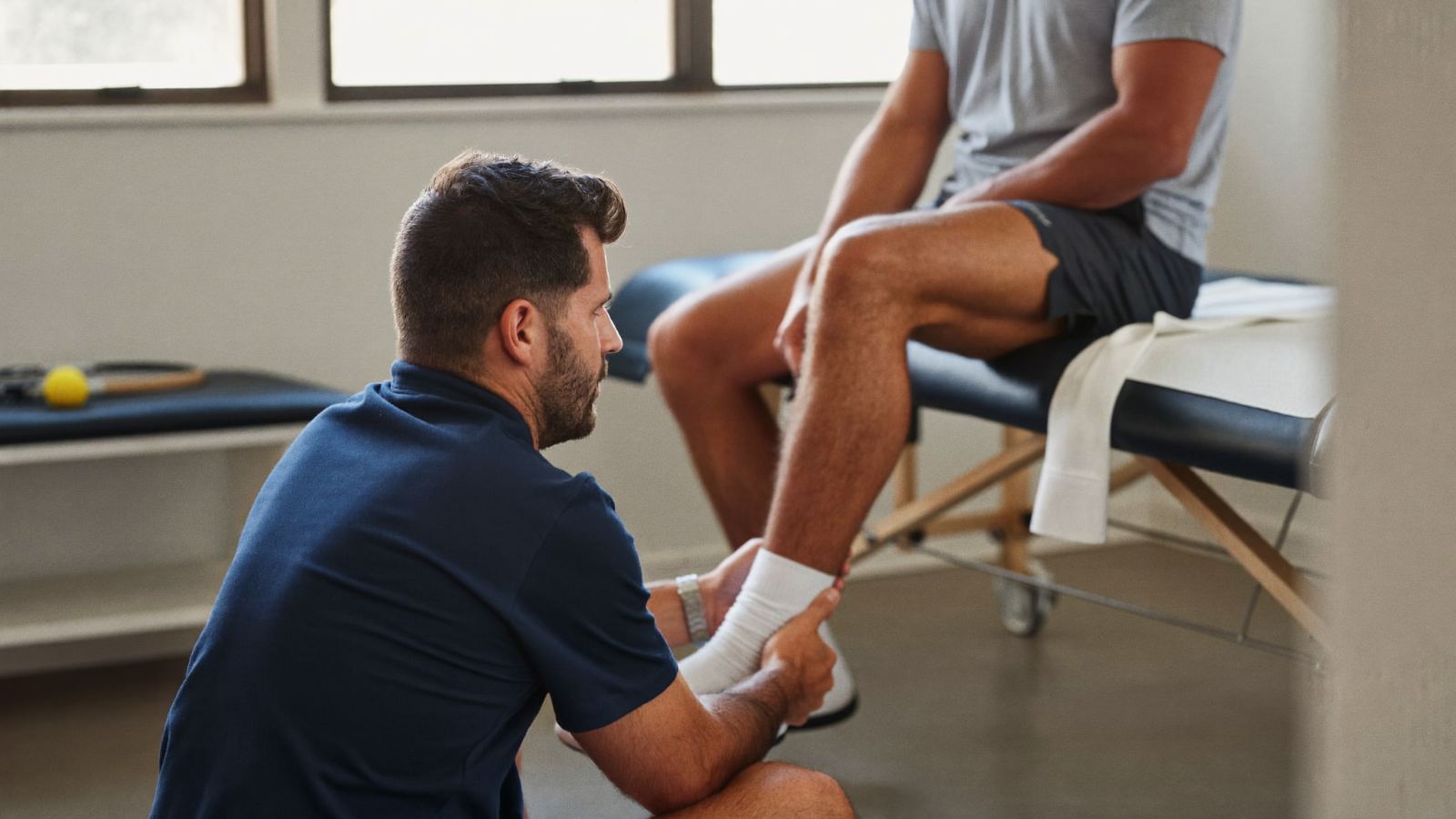
Pickleball injuries rarely start on the court. They start months earlier — in an ankle that quit moving, a calf that never got strong again after the last strain, a hip that stopped rotating years ago. The court just found it.
Pickleball is the fastest-growing sport in America. 24.3 million Americans played in 2025, up 171% in three years. Emergency departments are seeing the other half of that number.
What’s the most common injury in pickleball?
The most common pickleball injuries are strains and sprains, roughly 33% of pickleball injuries treated in U.S. emergency departments, followed by fractures at about 28%. Ankles, calves, Achilles tendons, wrists, shoulders and elbows take the most damage. Falls cause about 63% of injuries in players over 60.
Pickleball injuries are on the rise — and the average injured player is 64
A 10-year national review of orthopedic pickleball injuries found a mean patient age of 64, with 91% of orthopedic pickleball injuries happening in players 50 and older. Emergency visits are up 88% since 2020. More than half of all fractures landed in the wrist or forearm — the signature of a fall onto an outstretched hand.
There is a sex split worth knowing. Men are about 3.5 times more likely to show up with a strain or sprain. Women are about 3.7 times more likely to show up with a fracture, and 9.3 times more likely to fracture a wrist. That is a bone density conversation as much as a sports conversation.
The 10 most common pickleball injuries
What we actually evaluate, what causes it, and honest recovery ranges. Your timeline depends on how long the problem was building before it broke.
| Injury | What is actually causing it | Typical recovery |
|---|---|---|
| Ankle sprain | A hard lateral cut on an ankle that lost motion years ago | 2–6 weeks |
| Calf strain (“tennis leg”) | Pushing off backward with an under-conditioned calf | 3–8 weeks |
| Achilles tendinopathy | Repeated stop-start loading on a stiff, weak calf | 8–12 weeks (rupture: 6–12 months) |
| Rotator cuff strain or tear | Overhead serves with poor shoulder blade control | 6–12 weeks with rehab |
| Pickleball elbow (lateral epicondylitis) | Flicking from the wrist because the shoulder is not driving the paddle | 6–12 weeks, longer if ignored |
| Wrist fracture | Falling backward onto an outstretched hand | 6–8 weeks immobilized, then rehab |
| Knee and meniscus pain | Pivoting through the knee because the hip will not rotate | 4–8 weeks |
| Low back strain | Reaching low for dinks with a rounded spine, no hip hinge | 2–6 weeks |
| Plantar fasciitis and heel pain | A sudden jump in playing volume in the wrong shoes | 6–12 weeks |
| Eye injuries | A ball or paddle to the face at the kitchen line | Same-day evaluation, always |
Notice the pattern. Almost none of these are freak accidents. They are movement problems that finally ran out of room. Pain is the last thing to show up, not the first.
Which sport has more injuries, tennis or pickleball?
Tennis still produces more total emergency visits, but that gap closed fast. Among seniors, pickleball injuries caught up to tennis by 2018 while tennis stayed flat. The bigger difference is not volume — it is where you get hurt and how.
| Pickleball | Tennis | |
|---|---|---|
| Typical injured player | Age 60+, often new to the sport | Wider age range, long-time players |
| Leading mechanism | Slip, trip or fall (~63% of senior injuries) | Overuse and repetitive overload |
| Where it shows up | Ankle, calf, Achilles, knee, plus wrist fractures | Shoulder, elbow, wrist, low back |
| Ten-year trend | Climbing sharply | Relatively flat |
Why is pickleball so injury prone?
The court is small, so the sport feels safe. That is the trap. A small court means you are never running — you are reacting. Backpedaling for a lob. Split-stepping and cutting sideways. Lunging at the kitchen line and stopping short. Those are high-demand movements, and most people arrive with a body that has not been asked to do them in twenty years.
Then there is volume. Nobody plays pickleball once a week. They play four days a week, three hours at a time, six weeks after picking up a paddle. Your tendons adapt slower than your enthusiasm does. This is not random — if your calf goes and then your opposite hip starts aching, your body is compensating around something that was already there.
How to prevent pickleball injuries
- Stop backpedaling. Turn, run, set your feet. Backpedaling for lobs is how players end up falling onto a wrist.
- Wear court shoes, not running shoes. Running shoes have no lateral support and roll under a hard cut.
- Warm up 6–8 minutes. Ankle circles, leg swings, hip openers, dinks at half speed. Not static stretching.
- Train calves and hips twice a week. Heel raises, step-downs, split squats.
- Add playing time gradually. Increase weekly volume by about 10%, not 100%.
- Wear protective eyewear. Most players skip it. It is the one item on this list with a five-second fix.
- Fix the asymmetry before it tears. A stiff ankle or a hip that will not rotate is a tendon injury with a start date.
When you should get checked out
Go to urgent care or the emergency department the same day if you felt a pop or snap in your calf or heel, cannot put weight through the leg, have a deformed or rapidly swelling wrist after a fall, took a ball or paddle to the eye, or have new numbness, weakness or vision change. Those need imaging, not a stretching routine.
Everything else — the elbow that has nagged for six weeks, the heel that hurts the first ten minutes every morning, the shoulder that only complains on serves — is worth an assessment before it becomes the thing that costs you a season.
Treating pickleball injuries in Lombard, IL
Most pickleball injuries get treated where they hurt. Ice the elbow, rest the calf, tape the ankle, go back out, get hurt again. That is symptom chasing, and it is why the same injury keeps showing up on the same side.
We look at the whole chain instead — how your ankle, hip and shoulder actually move, which side you are loading, and what your body has been compensating around. Then we build a plan around it: adjustments to restore the motion you lost, shockwave therapy for stubborn tendon pain in the elbow, Achilles or plantar fascia, rehab that rebuilds calf and hip strength, massage therapy alongside adjustments where guarding is holding a joint back, custom orthotics made in our Lombard office when foot mechanics are driving it, and acupuncture and chiropractic together when pain is limiting how hard you can train.
The goal is not to get you comfortable enough to keep playing hurt. It is to fix the reason it happened. More on how we work with athletes: what a sports chiropractor does and when to stop waiting on a sports injury. We see players from Lombard, Glen Ellyn, Wheaton, Villa Park, Elmhurst and across DuPage County.
Pickleball injuries FAQ
How long does it take to recover from pickleball injuries?
Most soft-tissue pickleball injuries take 2 to 8 weeks. Tendon problems like pickleball elbow or Achilles tendinopathy usually run 8 to 12 weeks because tendons remodel slowly. A wrist fracture is typically 6 to 8 weeks immobilized plus rehab, and a full Achilles rupture can take 6 to 12 months.
Is pickleball a high injury sport?
Not compared to contact sports. The risk comes from who plays it and how much. Ninety-one percent of orthopedic pickleball injuries occur in players 50 and older, and most of those players jumped to four or five sessions a week without building the ankle, calf and hip capacity the movements require.
Are pickleball injuries common in seniors?
Yes. The mean age of an injured player is 64, and about 63% of senior injuries come from a slip, trip or fall rather than a swing. Women over 60 are roughly 9 times more likely than men to fracture a wrist, which makes balance work and bone health part of the plan.
Is pickleball harder on your body than tennis?
It loads you differently. Tennis demands more from the shoulder, elbow and back. Pickleball concentrates stress in the ankle, calf and Achilles through constant short stops and direction changes, and its fall rate drives wrist and hip fractures in older players.
How do you prevent pickleball injuries?
Wear court shoes, warm up six to eight minutes, train calves and hips twice a week, add playing time by about 10% a week, wear protective eyewear, and never backpedal for a lob. Then get any stiff joint or lingering ache assessed before it becomes the injury.
Book your New Patient Discovery Assessment
If pickleball has left you with an elbow, calf, heel or shoulder that keeps flaring up, let’s get to the root of it instead of taping over it. Book your New Patient Discovery Assessment at True Health Chiropractic and Acupuncture in Lombard.
Reviewed by Dr. Amanda Myers, DC, MS. Last updated August 14, 2026. This article is general education, not a diagnosis. If you are hurt, get assessed.
5 Responses