Your back hurts. Not just today — for weeks, months, maybe years. You have tried physical therapy. You have tried injections. You have tried other chiropractors. You have iced, stretched, taken ibuprofen, bought a new mattress, gotten a standing desk. Each thing helped for a while. Then it came back. Or it never really left.
The reason back pain keeps coming back is not that nothing works. It is that nobody has found the actual cause yet. Most back pain treatment focuses on the area that hurts. The cause is usually somewhere else — a hip that does not move, a movement pattern that overloads the lower back, a structural compensation that has been building for years. At True Health, we start by figuring out what is actually causing your back pain. Then we build a plan with a real endpoint.
What back pain actually is
“Back pain” is not a single thing. It is an umbrella term that covers very different conditions with very different solutions. The most common types we see at True Health:
- Muscle strain or sprain — usually acute, often from a specific event (lifting, sudden twist). Resolves with appropriate care.
- Disc-related back pain — bulges or herniations pressing on nerves. Often radiates into the buttock, hip, or leg.
- Facet joint dysfunction — the small joints between vertebrae become irritated, often from repetitive extension or arthritic change.
- Sacroiliac (SI) joint dysfunction — pain in the low back and buttock where the spine meets the pelvis. Common postpartum and in runners.
- Postural and movement-pattern back pain — the most common type in our desk-worker patients. Years of sitting with the pelvis tilted creates chronic loading the back was never designed for.
- Compensation from a hip, knee, or foot problem — when something upstream or downstream is not working, the low back picks up the slack and eventually breaks down.
The treatment plan changes dramatically based on which type you have. That is why we start with a thorough Discovery Assessment instead of a generic protocol.
Why your back pain keeps coming back
If you have had multiple flares of back pain over years, here is what is usually happening: each flare gets treated as a separate event. Rest, ibuprofen, a few visits somewhere, the pain calms down, life goes on. Then it happens again. Then again. Each time slightly worse.
The cause is not random. The cause is consistent. There is something in how you move, how you sit, how you sleep, or how your structure has adapted that is repeatedly overloading the same spot. Until that is identified and changed, the flares keep happening. The patients who finally break the cycle are the ones who get a full assessment that traces the symptom back to the root pattern — and then actually address that pattern, not just the symptom.
This is the difference between treatment that gets you out of pain temporarily and treatment that gets you to an actual endpoint.
How True Health treats back pain
Back pain treatment at True Health moves through three phases:
Phase 1 — Discovery Assessment. Forty-five to sixty minutes. Full history of the current pain and prior flares. Hands-on exam of the painful area and everything connected to it. Posture and movement screening. Orthopedic and neurological testing. Imaging review if you have any. By the end we know what type of back pain you have, what is actually causing it, and what a real plan looks like.
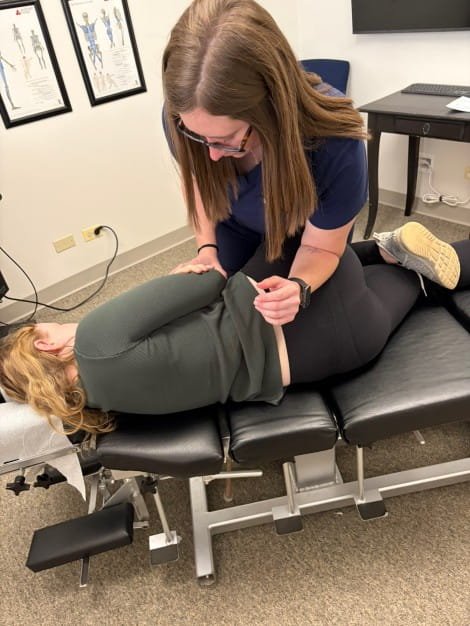
Phase 2 — Take pressure off and reduce pain. Specific chiropractic adjustments to restore motion to the segments involved. Soft tissue work on the muscles that are guarding. Acupuncture for inflammation and pain control when indicated. Spinal decompression therapy for disc-related cases. Specific positioning and activity guidance for the acute phase.
Phase 3 — Rebuild what failed. Core, glute, and hip stability work to retrain the patterns that protect the low back. Movement coaching for how you lift, sit, sleep, and exercise. Workstation modifications for desk workers. This is the phase that decides whether the back pain is fixed or just temporarily quiet.
Most patients feel meaningful relief within four to six visits. Full resolution and stabilization typically takes ten to twenty visits over eight to sixteen weeks. The patients who follow through the full plan are the ones who stay out of the chair long-term.
When back pain needs urgent medical attention
Most back pain is mechanical and not dangerous. There are exceptions that need immediate medical attention, not chiropractic. Seek emergency care if you have back pain accompanied by:
- Loss of bowel or bladder control or numbness in the saddle area
- Significant progressive weakness in one or both legs
- Foot drop or loss of foot control
- Back pain with unexplained fever, severe abdominal pain, or significant weight loss
- Back pain following a significant fall, car accident, or trauma
- Sudden severe back pain in someone with a history of cancer or osteoporosis
These can indicate serious conditions requiring immediate evaluation. For the vast majority of back pain that does not include these red flags, conservative care including chiropractic, rehabilitation, and acupuncture is the appropriate first approach — and usually resolves the problem.
Common questions about back pain treatment
Can a chiropractor actually fix chronic back pain?
Yes — when the chiropractor addresses the cause, not just the painful spot. Chronic back pain almost always has a structural or movement-pattern cause that previous treatment missed. Our approach combines chiropractic adjustments to restore joint motion, soft tissue work and acupuncture to calm inflammation, and rehabilitation to fix the underlying pattern that overloaded the back. Most chronic back pain patients see significant improvement when the actual cause is finally identified and addressed.
How long does it take to fix back pain?
Most patients notice meaningful improvement within four to six visits. Full resolution — including rebuilding the stability that prevents recurrence — typically takes ten to twenty visits over eight to sixteen weeks. The timeline depends on how long the pain has been there, how chronic the underlying pattern is, and your age and overall health. Acute back pain from a recent event resolves faster than chronic back pain that has been building for ten years. We give you a realistic timeline at your Discovery Assessment.
Will I need an MRI before starting back pain treatment?
Usually not. A thorough physical examination is sufficient for the majority of back pain cases. We will recommend imaging if your symptoms suggest a specific structural problem that requires imaging confirmation, or if your case is not responding to conservative care as expected. We do not require imaging as a precondition for starting care. Your Discovery Assessment determines what is needed in your specific case.
Should I rest or move with back pain?
Movement, usually — within reason. Extended bed rest actually slows recovery from most back pain. Gentle walking, specific stretches, and movement within tolerance generally accelerate healing. Heavy lifting, twisting under load, and high-impact activity usually need to be modified during the acute phase. We give every back pain patient a specific list of what is okay and what to avoid based on the type of back pain they have.
Is chiropractic safe for chronic back pain or just acute injuries?
Both. Chiropractic care has a strong safety record and is well-suited for both acute back injuries and chronic back pain. For chronic cases we typically use a combination of adjustments, soft tissue work, acupuncture, and rehabilitation — addressing both the immediate pain and the underlying patterns that have built up over time. We modify techniques based on your specific case, age, and any other health considerations.
Can I avoid surgery for my back pain?
For the vast majority of back pain patients, surgery is not necessary. Most back pain — including most disc-related pain — responds to conservative care when the plan addresses the actual cause. Surgery is appropriate for specific situations: progressive neurological deficits, foot drop, loss of bowel or bladder function, or cases that have failed at least eight to twelve weeks of well-designed conservative care. We recommend exhausting conservative options first. Surgery is permanent. Conservative care is not.
Does insurance cover chiropractic care for back pain?
Most major medical plans cover chiropractic care for back pain. We verify your specific coverage before your first visit so you know exactly what is covered, what your copay is, and what your deductible looks like. We also accept HSA and FSA payments, auto insurance (PIP) if your back pain resulted from a car accident, and workers comp for work-related injuries.
Why does my back pain feel worse in the morning?
Morning back pain that improves as you move is usually a sign of inflammation or stiffness that builds overnight when you are not moving — common in disc issues, arthritis, and chronic muscle guarding. Morning pain that gets worse as the day continues is usually structural or mechanical loading. The pattern of when your back hurts gives us important information about what is causing it. We map this out in your Discovery Assessment.
Back pain treatment across DuPage County
We treat back pain patients from across the western suburbs:
- Back pain treatment for Lombard patients
- Back pain treatment for Wheaton patients
- Back pain treatment for Glen Ellyn patients
- Back pain treatment for Downers Grove patients
- Back pain treatment for Elmhurst patients
- Back pain treatment for Naperville patients
- Back pain treatment for Oak Brook patients
- Back pain treatment for Villa Park patients
- Back pain treatment for Addison patients
Our office is at 477 E Butterfield Rd Ste 205, Lombard, IL 60148 — easy access from I-355, I-88, and Butterfield Road.
Related conditions and treatments
- Sciatica treatment — for back pain that radiates down the leg
- Herniated and bulging disc treatment
- Spinal decompression therapy — for disc-related back pain
- Prenatal back pain and pregnancy care
- Neck pain and tech-neck treatment
Find out what is actually causing your back pain.
Book a Discovery Assessment. Full exam, real answers, a clear plan with a real endpoint. No pressure, no commitment until it makes sense to you.
Book Your Discovery Assessment
Or call us: (630) 796-2083