
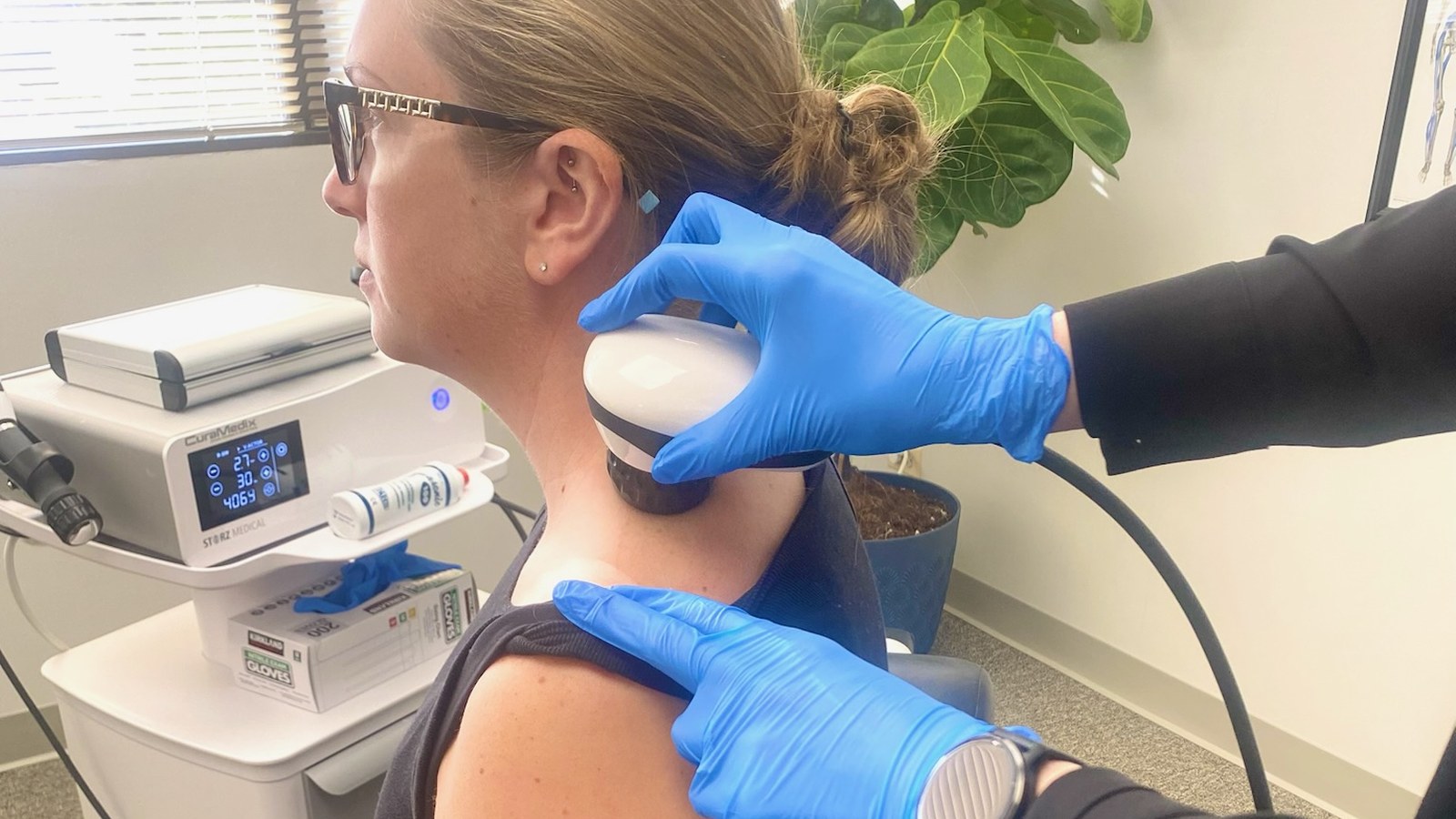
By Dr. Amanda Myers, DC, MS · Last updated September 9, 2026
You looked up shockwave therapy because something chronic — plantar fasciitis, tennis elbow, a tendon that will not heal — has outlasted everything else you tried. Then you saw the price question has no straight answer anywhere.
Here are the honest numbers.
Shockwave therapy cost in the U.S. typically runs $100 to $500 per session, with most clinics charging $150 to $300. Most conditions need 3 to 6 sessions, so a full course usually lands between $450 and $1,800. Most insurance plans do not cover it, but HSA and FSA funds usually apply.
What shockwave therapy costs, in real ranges
Prices vary because clinics, devices, and conditions vary. What you can expect nationally:
| What you are paying for | Typical range |
|---|---|
| Single session | $100–$500 (most commonly $150–$300) |
| Full course (3–6 sessions) | $450–$1,800 |
| Package pricing | Usually 10–20% below per-session rates |
| Focused (higher-energy) devices | Top of the range — deeper penetration, stronger evidence for some conditions |
| Radial devices | Lower end of the range — effective for many surface-level tendon problems |
At True Health in Lombard, shockwave is quoted as part of your plan — the exact number depends on your condition and how many sessions your case actually needs, which is exactly what the 3-to-6-session question comes down to. We tell you the full cost before you commit to anything. No surprises mid-plan.
Is shockwave therapy covered by insurance?
Usually not, and you deserve the straight answer on why. Most insurance companies still classify extracorporeal shockwave therapy as “experimental or investigational” for musculoskeletal conditions — despite the research behind it — so most plans, including Medicare in most cases, decline it. A few plans make exceptions for specific diagnoses, so it is always worth a call to your insurer with the CPT code your provider gives you.
What usually does work: HSA and FSA funds. Shockwave therapy for the treatment of a diagnosed condition is generally a qualified medical expense, which means you can pay with pre-tax dollars. Bring your card; ask for an itemized receipt.
Is it worth paying cash for?
That depends on what you are comparing it to — and this is where most people compare wrong.
A cortisone shot is often covered by insurance, so it feels cheaper. But cortisone quiets the pain without fixing the tissue, wears off in weeks to months, and repeated injections can weaken the tendon you are trying to save. Surgery is also usually covered — along with weeks off work, rehab, and real risk. Shockwave sits in between: it stimulates the tissue to actually repair, the research on stubborn tendon problems is solid, and the total cost of a full course is often less than your surgical deductible alone.
The honest caveat: shockwave is not magic, and it is not for everyone. Roughly 2 out of 3 patients with chronic tendon problems get meaningful improvement, results build over weeks as tissue remodels, and the right candidate matters more than the machine. That is why we assess first and recommend second. If shockwave therapy is not the right tool for your case, we will tell you — sometimes laser therapy or a corrective care plan is the better fit.
Why some clinics charge $100 and some charge $500
Four things drive the spread: the device (focused units cost clinics several times what radial units do), who applies it (a licensed provider who maps the treatment to your exam versus a technician running a preset), what is bundled (some quotes include the exam and rehab guidance, some are the wand and nothing else), and your market (big-city specialty clinics price higher). A cheap session with the wrong device on the wrong tissue is the most expensive option of all — you pay and nothing changes.
Shockwave therapy cost questions, answered straight
How much does shockwave therapy cost per session?
Between $100 and $500 per session in the U.S., with most clinics in the $150 to $300 range. Focused-device treatments and specialty clinics sit at the top of the range; radial-device treatments at smaller clinics sit near the bottom.
Is shockwave therapy covered by insurance?
Most plans do not cover it for musculoskeletal conditions because they still classify it as experimental, and Medicare declines it in most cases. A few plans cover specific diagnoses, so call your insurer before assuming either way. HSA and FSA funds generally do apply.
Is shockwave therapy worth the money?
For the right candidate — a chronic tendon or fascia problem that has not responded to rest, stretching, or injections — the evidence says yes for roughly 2 out of 3 patients. A full course often costs less than a surgical deductible. For the wrong candidate, no price is worth it, which is why an assessment should come first.
Can I use my HSA or FSA for shockwave therapy?
Generally yes. Shockwave therapy prescribed for a diagnosed condition qualifies as a medical expense under most HSA and FSA rules. Pay with your benefits card or submit an itemized receipt for reimbursement.
How many sessions of shockwave therapy will I need?
Most conditions respond within 3 to 6 sessions, spaced about a week apart. We wrote a full breakdown of how many shockwave sessions different conditions need — and what it means if you are not improving by session three.
The most expensive treatment is the one that does not work. Find out whether shockwave is the right tool for your case — and exactly what it would cost — before you spend a dollar. Book your New Patient Discovery Assessment and let’s get to the root of this.
2 Responses