
By Dr. Amanda Myers, DC, MS · Last updated September 22, 2026
Your knee hurts on stairs. It aches after you sit, stiffens up in the morning, and swells a little when you push it. You have tried rest, ice, maybe a cortisone shot that helped for a while and then wore off.
Here is the part most people are not told: knee pain that keeps coming back is not random. Something in the tissue — a tendon, the joint surface, the tissue around it — has stopped healing on its own. Shockwave therapy for knee pain exists for exactly that problem.
Shockwave therapy for knee pain uses focused acoustic pulses to restart healing in tissue that has stalled — increasing blood flow, stimulating repair, and calming irritated nerve endings. Research shows meaningful pain and function improvements for knee arthritis and tendon problems, typically across 6 to 12 weekly visits, with no needles, medication, or downtime.
How shockwave therapy for knee pain works
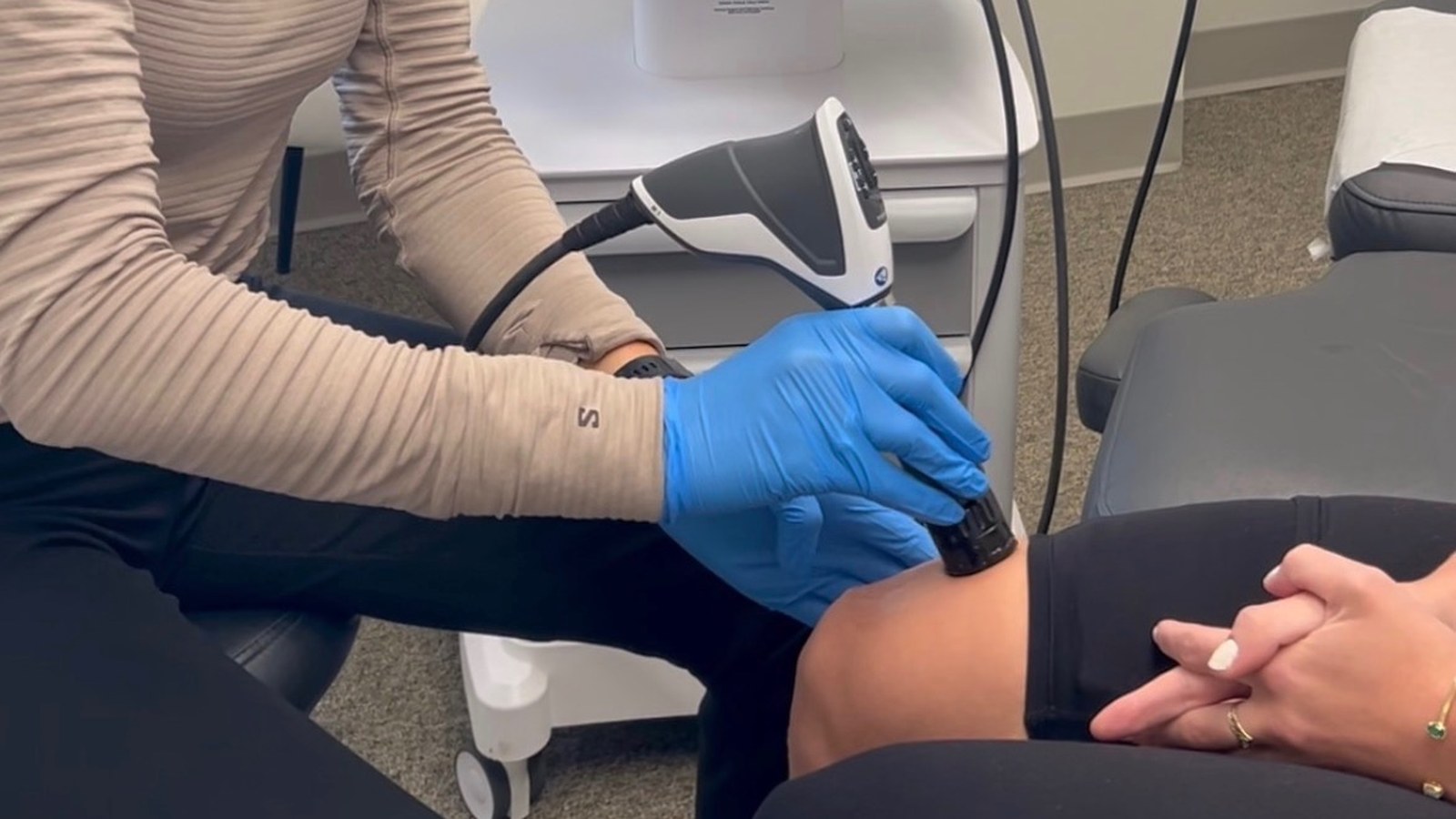
A radial shockwave device delivers rapid acoustic pulses through the skin into the injured tissue. That does three useful things.
First, it triggers a controlled micro-stress that tells your body the area needs attention — new blood vessels form and repair activity picks up. Second, it stimulates the cells that rebuild tendon and connective tissue. Third, it dials down the over-sensitized nerve endings that keep a chronic knee hurting long after the original problem started.
In short: it does not mask the pain. It goes after the reason the tissue stopped healing. We are not just chasing symptoms.
The knee problems shockwave helps most
Shockwave has the strongest track record for chronic, stubborn problems — the ones that have hurt for months, not days:
- Knee osteoarthritis pain — including moderate arthritis you have been told is just wear and tear
- Patellar tendinopathy (jumper’s knee) — pain just below the kneecap with jumping, squatting, or stairs
- Quadriceps and hamstring tendon pain where the tendons attach around the knee
- Runner’s knee and overuse pain that flares every time you return to activity
Just as important is what it does not fix. A fresh ligament tear, a knee that locks or gives way, or a hot, swollen joint needs an examination and possibly imaging first — not a course of shockwave. An honest assessment comes before any plan at our office.
Shockwave vs. cortisone vs. waiting it out
| Shockwave therapy | Cortisone injection | Rest and NSAIDs | |
|---|---|---|---|
| What it targets | The stalled healing in the tissue itself | Inflammation and the pain signal | Symptoms while you wait |
| Needles or drugs | None | Injection, often repeated | Daily medication |
| How relief builds | Gradually, over weeks, as tissue remodels | Fast, then commonly fades | Only while you avoid activity |
| Effect on tissue quality | Stimulates repair | Repeated shots can weaken tendon tissue | No change to the underlying problem |
| Downtime | None — walk out and go about your day | Usually 1–2 days of caution | Ongoing activity limits |
Cortisone has a place. But if you have already had a shot or two and the pain keeps returning, that is your knee telling you the underlying tissue never actually recovered. There is a reason this keeps coming back.
What the research actually shows
Shockwave therapy for knee pain is not a fringe idea. A 2024 meta-analysis of randomized trials found extracorporeal shockwave therapy reduced pain and improved knee function in people with knee osteoarthritis, and it is considered an effective conservative option before injections or surgery are on the table.
Two honest caveats. Results build over weeks — this is tissue remodeling, not a light switch. And no provider can promise shockwave will regrow lost cartilage. What the evidence supports is less pain and better function — the two things that decide whether you can take stairs, walk the dog, and sleep comfortably.
What knee shockwave looks like at our Lombard office
At True Health in Lombard, we use a CuraMedix radial shockwave system — the same class of device used in sports medicine clinics. Gel goes on the knee, the applicator delivers rhythmic pulses over the painful area for about 5 to 10 minutes, and the intensity is adjusted to you in real time. Most patients describe it as an intense tapping, around a 3 to 5 out of 10 — uncomfortable, not painful.
A plan of shockwave therapy for knee pain typically runs 6 to 12 weekly visits depending on how long the problem has been there. And because a knee rarely fails in isolation — your body compensates through the hip, the ankle, the way you move — we pair shockwave with an assessment of the whole chain and targeted rehab. Treating the knee without fixing what overloaded it is how people end up starting over every year.
When knee pain needs a doctor first
Some knees need medical evaluation before any conservative care: a knee that locks, buckles, or cannot bear weight; significant swelling after an injury; redness and warmth with fever; or night pain that does not change with position. If we see those signs at your assessment, we will tell you plainly and point you to the right physician. That is part of the job.
Frequently asked questions
Is shockwave therapy better than a cortisone injection?
They do different jobs. Cortisone calms inflammation fast but fades and does not repair tissue — and repeated shots can weaken tendons. Shockwave builds relief more slowly by stimulating the tissue to heal. For chronic knee pain that keeps returning after injections, shockwave addresses the part cortisone never touched.
What are the downsides of shockwave therapy?
The main ones are mild: temporary soreness, redness, or a bruised feeling for a day or two after treatment. It is not appropriate over an active infection, a tumor, or a fresh fracture, and results take weeks rather than days. It also requires showing up — single sessions do not remodel tissue.
Does shockwave therapy work for bone-on-bone knee arthritis?
Advanced arthritis responds less than mild or moderate arthritis, and shockwave will not rebuild lost cartilage. That said, studies including severe knee osteoarthritis show pain and function can still improve, which for some people delays or avoids more invasive options. An honest exam tells us whether shockwave therapy for knee pain is realistic for your case.
Can shockwave therapy make knee pain worse?
You may feel post-workout-style soreness for 24 to 48 hours — that is the treatment stimulating the tissue, and it settles on its own. Lasting worsening is rare when the right condition is treated at the right intensity, which is why we examine the knee first and adjust the device in real time.
How many shockwave therapy sessions do I need for knee pain?
Most knee problems need a course of weekly sessions — commonly 6 for tendon problems and up to 12 for arthritis, reassessed as you go. Chronic problems that took years to build do not resolve in one visit, and we will tell you early whether you are responding.
Your knee should not decide your stairs, your workouts, or your sleep. If knee pain has been running your schedule — or you are weighing what a course of shockwave costs against another injection — let’s figure out whether shockwave therapy for knee pain is your answer. Learn more about shockwave therapy at True Health in Lombard, then Book your New Patient Discovery Assessment and let’s get to the root of this.