
Looking for plantar fasciitis treatment that actually lasts? The first step out of bed in the morning is the worst — a sharp, stabbing pain in the heel that takes a hundred steps to walk off. By mid-morning it has settled. By evening, after a day on your feet, it is back. You have tried the inserts. You have tried stretching the calf. You have tried new shoes. The pain keeps coming.
Chronic plantar fasciitis is one of the most frustrating foot conditions because the typical advice — stretching, icing, ibuprofen — works for some people and fails for many. At True Health we treat plantar fasciitis with a different approach: address the actual cause, and for chronic cases that have not responded to other treatment, use shockwave therapy (EPAT) to stimulate healing where rest alone has failed.
What plantar fasciitis actually is
Your plantar fascia is a thick band of connective tissue that runs along the bottom of your foot from your heel to your toes. It acts like a tension cable, supporting the arch of your foot every time you take a step.
Plantar fasciitis happens when this fascia becomes inflamed, irritated, or develops small tears — usually from repetitive overload. The classic sign is sharp heel pain with your first steps in the morning, easing as you walk but returning after periods of rest or long days on your feet.
The condition is incredibly common in runners, walkers, healthcare workers, teachers, retail workers, and anyone who spends long hours on their feet. It is also common in people with sudden activity changes — new exercise routines, weight changes, or new shoes.
Why plantar fasciitis happens — and why it does not heal
The plantar fascia gets overloaded for specific reasons. Until those reasons are addressed, the condition tends to persist or recur. The most common drivers we see:
- Tight calves and Achilles tendons — when the calf cannot stretch through the full ankle range, the plantar fascia takes the strain
- Weak intrinsic foot muscles — the small muscles inside the foot are supposed to help support the arch; when they are weak, the fascia does all the work
- Hip and glute weakness — when the hip cannot stabilize, the leg rotates inward, the arch collapses, and the fascia overloads
- Joint restrictions in the foot or ankle — if the ankle, midfoot, or big toe cannot move normally, force transfers to the fascia
- Sudden activity or weight changes — new running plan, new job on feet, post-pregnancy weight
- Poor footwear — though “good shoes” alone rarely fix the underlying problem
Most plantar fasciitis treatment focuses only on the fascia itself — stretching it, icing it, ibuprofen, inserts. That gives temporary relief. It does not address why the fascia is getting overloaded in the first place. That is why it keeps coming back.
How True Health treats plantar fasciitis — including shockwave therapy
At True Health we treat plantar fasciitis with an approach designed for both acute relief and long-term resolution:
Phase 1 — Discovery Assessment. Full foot, ankle, knee, and hip evaluation. Movement and gait screening. Identification of the specific contributors to your case.
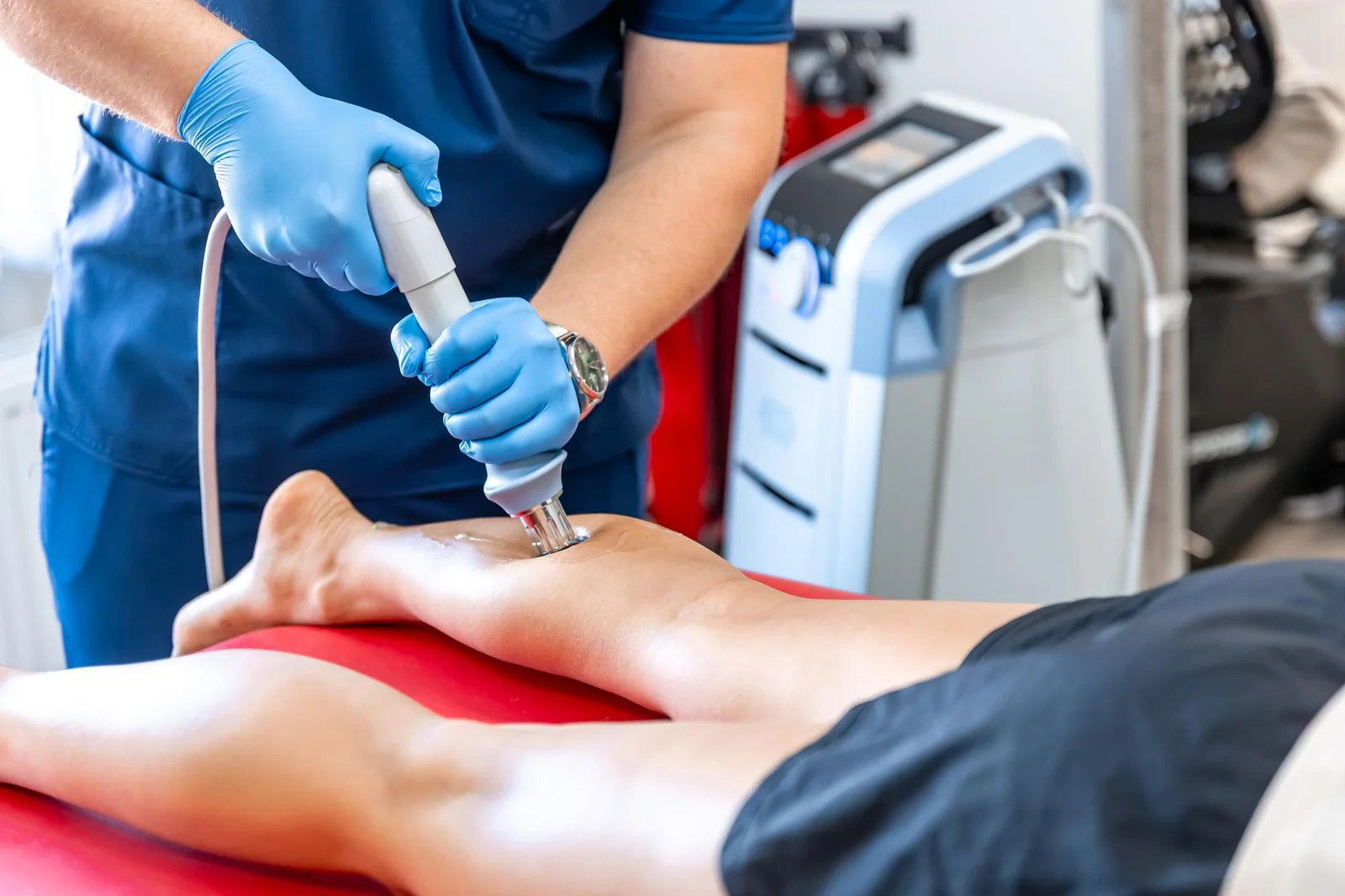
Phase 2 — Address acute pain and tissue. Specific soft tissue work to the plantar fascia, calf, and posterior chain. Joint adjustments to the foot, ankle, and any restricted segments. Acupuncture for pain control when appropriate. For chronic cases, shockwave therapy (EPAT) — research-backed for plantar fasciitis that has not responded to other treatment.
Phase 3 — Fix the cause. Specific calf and Achilles mobility work. Intrinsic foot strengthening. Hip and glute work for the patients whose problem starts up the chain. Footwear and activity modifications.
Most patients with acute plantar fasciitis see significant improvement in four to six visits. Chronic cases — those that have been going for months or years — typically respond to shockwave protocols of four to six sessions over four to six weeks.
What shockwave therapy is and why it works for plantar fasciitis
Shockwave therapy (EPAT — Extracorporeal Pulse Activation Technology) uses acoustic pressure waves to stimulate healing in chronic soft tissue injuries that have not responded to traditional treatment. It is non-invasive — no needles, no medication, no downtime — and it has strong research support for plantar fasciitis.
The mechanism: the pressure waves create a controlled micro-trauma to the affected tissue, which triggers the body’s healing response. New blood vessels form. Collagen reorganizes. The fascia gets the stimulus to actually heal rather than stay stuck in a chronic inflammatory state.
Treatment takes about ten to fifteen minutes per session. Most patients describe the sensation as a strong tapping that is uncomfortable but tolerable. A typical protocol is four to six sessions over four to six weeks. Most patients see significant improvement during the treatment series and continued improvement in the weeks after.
Shockwave is particularly effective for plantar fasciitis that has persisted longer than three months and has not responded to rest, stretching, ibuprofen, inserts, or generic physical therapy.
Common questions about plantar fasciitis treatment
Will chiropractic actually help my plantar fasciitis?
Yes — when the chiropractor treats the whole chain, not just the foot. Most plantar fasciitis is the result of dysfunction somewhere else: calf tightness, hip weakness, ankle restriction, gait pattern. Addressing only the fascia gives temporary relief. Addressing the cause gives lasting resolution. We combine soft tissue work, joint adjustments, corrective exercise, and (for chronic cases) shockwave therapy. Most patients see significant improvement within four to six visits.
What is shockwave therapy and how does it work for plantar fasciitis?
Shockwave therapy (EPAT) uses acoustic pressure waves to stimulate healing in chronic plantar fasciitis. The pressure waves create controlled micro-trauma that triggers a fresh healing response in tissue that has been stuck in chronic inflammation. It is non-invasive, takes about ten to fifteen minutes per session, requires no medication or downtime, and has strong research support specifically for plantar fasciitis. Most patients complete a series of four to six sessions over four to six weeks and see significant improvement.
Does shockwave therapy hurt?
Most patients describe it as uncomfortable but tolerable — a strong, rhythmic tapping sensation. The intensity is adjusted to what you can handle. Some mild soreness afterward is normal. There is no needles, no anesthesia required, no downtime. You can walk out of the appointment and return to normal activity.
How long does it take to recover from plantar fasciitis?
Acute plantar fasciitis (less than three months) often resolves significantly within four to six visits of conservative care. Chronic plantar fasciitis (longer than three months, especially longer than a year) typically responds to shockwave protocols of four to six sessions over four to six weeks. Most patients see meaningful improvement during the treatment series and continued improvement in the following weeks. Patients who address the underlying movement causes generally avoid recurrence.
Do I need a cortisone injection or surgery for plantar fasciitis?
Rarely. Most plantar fasciitis responds to conservative care including specific manual therapy, corrective exercise, and shockwave for chronic cases. Cortisone injections provide short-term relief but do not address the underlying cause and can weaken the fascia with repeated use. Surgery is rarely necessary. We recommend exhausting conservative care including shockwave before considering injections or surgery.
Will inserts fix my plantar fasciitis?
Inserts can provide temporary symptom relief by changing the load on the fascia, but they rarely fix the underlying cause. Long-term reliance on inserts often masks the problem rather than solving it. We use inserts strategically when appropriate, but the goal is to address the actual cause — calf tightness, foot weakness, hip dysfunction — so you do not need to depend on inserts permanently.
Does insurance cover plantar fasciitis treatment?
Most major medical plans cover chiropractic care for plantar fasciitis. Shockwave therapy coverage varies — some plans cover it, many do not. We verify your specific coverage and tell you upfront what is covered and what is self-pay. HSA and FSA payments are accepted. The investment in shockwave for chronic plantar fasciitis is typically much less than ongoing care, injections, or surgery.
Plantar fasciitis treatment across DuPage County
- Plantar fasciitis treatment for Lombard patients
- Plantar fasciitis treatment for Wheaton patients
- Plantar fasciitis treatment for Glen Ellyn patients
- Plantar fasciitis treatment for Downers Grove patients
- Plantar fasciitis treatment for Elmhurst patients
- Plantar fasciitis treatment for Oak Brook patients
- Plantar fasciitis treatment for Villa Park patients
- Plantar fasciitis treatment for Addison patients
Our office is at 477 E Butterfield Rd Ste 205, Lombard, IL 60148.
Stop walking on a heel that hurts every morning.
Book a Discovery Assessment. We will figure out the actual cause of the plantar fasciitis and build a plan — including shockwave if your case is chronic — to resolve it for real.
Book Your Discovery Assessment
Or call: (630) 796-2083