
By Dr. Amanda Myers, DC, MS · Last updated September 29, 2026
You have done your homework. Shockwave therapy has real evidence behind it, your neighbor swears by it for her plantar fasciitis, and you are ready to try it. Then you hit the next question: one clinic says radial, another says focused, and both insist theirs is the one that works. You should not have to untangle marketing on your own. Here is the honest version of radial vs focused shockwave therapy.
Radial and focused shockwave are the two main types of shockwave therapy. Radial devices spread pressure waves across a broad, shallow area — ideal for tendons and tissue within a few centimeters of the skin. Focused devices concentrate energy at a precise, deeper point. For most tendon and muscle problems, radial is the workhorse; focused matters for select deep targets.
What the two types actually are
The difference is physics, not branding.
A radial device uses a pneumatic mechanism — a projectile inside the handpiece strikes an applicator, and the pressure wave ripples outward through your skin like a stone dropped in water. Energy is highest at the surface and spreads as it goes deeper. That makes radial ideal for treating a broad region of shallow tissue: the sole of your foot, the outside of your elbow, the back of your heel.
A focused device generates its wave electromagnetically or piezoelectrically and converges it at a set depth — think of a magnifying glass concentrating light to a point. It can reach structures 6 centimeters or more below the skin and hit a target the size of a coin without loading everything above it.
Neither is an upgrade of the other. They are different tools for different depths.
Radial vs focused shockwave therapy: side-by-side
| Radial shockwave | Focused shockwave | |
|---|---|---|
| How the wave travels | Spreads outward from the skin surface | Converges at a programmed depth |
| Effective depth | Roughly 3–4 cm, strongest near the surface | Up to 6+ cm, precise focal point |
| Treatment area | Broad — covers the whole irritated region | Narrow — pinpoints one structure |
| What it feels like | Rapid rhythmic tapping; intensity is adjustable | Deeper pulse, often less surface sensation |
| Best-fit problems | Plantar fasciitis, tennis elbow, Achilles and patellar tendinopathy, calf and shoulder tendon pain, trigger points | Deep hip tendons, certain bone stress injuries, calcific deposits needing precise targeting |
| Typical setting | Chiropractic, sports medicine, and physical therapy clinics | Specialty and hospital-affiliated clinics; less common, usually pricier |
Which one is better? What the research actually says
Honest answer: it depends on the target, and the gap is smaller than the sales pages suggest.
Head-to-head trials exist, and in some of them focused shockwave edges out radial — a 2021 meta-analysis in plantar fasciitis found focused produced better pain scores at some follow-up points. That is worth knowing. But radial has its own deep evidence base for the conditions people actually walk in with — plantar fasciitis, tennis elbow, Achilles and patellar tendon pain — because those structures sit exactly where radial delivers its energy. Reviews of radial vs focused shockwave therapy for shallow tendon problems consistently find both effective, with success rates in the 60–80% range for stubborn tendinopathy that has failed rest, ice, and injections.
So the real question is not which device wins a lab comparison. It is: how deep is your problem, and is anyone treating the reason it started?
What we use at True Health in Lombard — and why
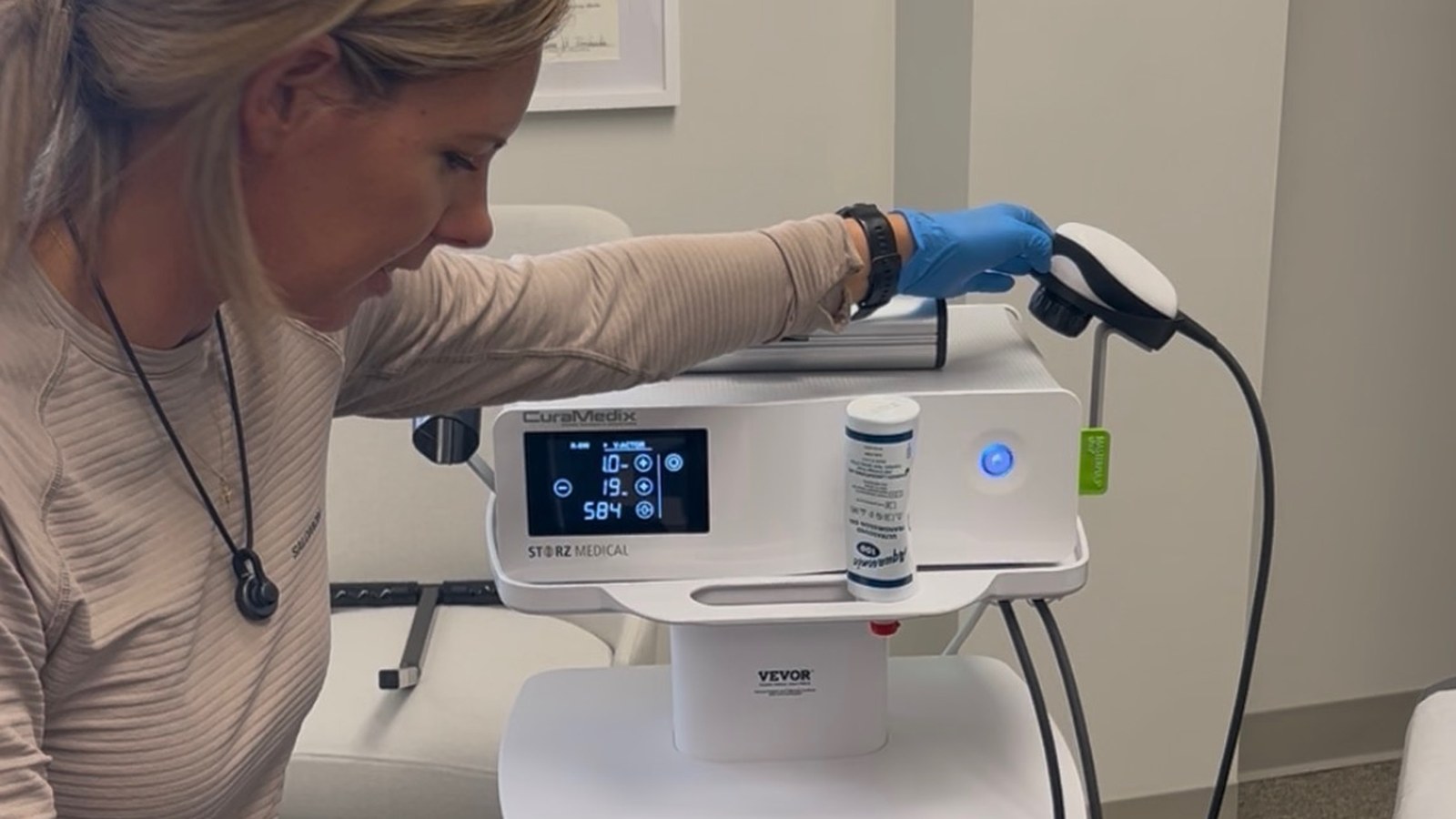
We use a Storz Medical radial shockwave system on the CuraMedix platform — the same class of device used in professional sports medicine settings. We chose radial deliberately: nearly everything we treat with shockwave sits within its reach. Heel and arch pain, elbow tendons, Achilles problems, knee tendinopathy, chronically tight calves and shoulders. If you are wondering what a session is like, here is an honest answer on whether shockwave hurts — and most plans run 6 to 12 visits as part of our shockwave therapy program.
Here is the part most clinics skip: the tendon that will not heal is usually the symptom, not the problem. Something overloaded it — a stiff joint above it, a movement pattern you have been compensating around, a foot that stopped absorbing shock. Shockwave restarts healing in tissue that has stalled. The rest of your plan fixes why it stalled. We are not just chasing symptoms.
And if your problem genuinely calls for focused shockwave — a deep hip tendon, a target radial cannot reach — we will say so and point you to the right provider. You should not have to guess which tool you need.
When to see a doctor first
Shockwave is not the first stop for everything. If you have numbness or weakness that is getting worse, pain that wakes you at night and does not change with position, a fever alongside the pain, or the pain started with a fall or accident, get a medical evaluation before any shockwave treatment — radial or focused. Your assessment here starts with figuring out whether shockwave belongs in your plan at all, and we refer out when it does not.
Frequently asked questions
What are the two main types of shockwave therapy?
Radial and focused. Radial spreads a pressure wave across a broad, shallow area and is the most common type in outpatient clinics. Focused concentrates energy at a precise, deeper point and is usually found in specialty settings.
Which shockwave therapy is the best?
Neither is best across the board. In the radial vs focused shockwave therapy comparison, radial fits shallow, spread-out problems like plantar fasciitis and tennis elbow, while focused fits deep, pinpoint targets. The right question is which one matches the depth of your condition — not which device a clinic happens to own.
How much does radial shockwave therapy cost?
Radial sessions typically run at the lower end of shockwave pricing — less than focused, which uses costlier equipment. We break down real numbers, package pricing, and insurance in our honest guide to shockwave therapy cost in Lombard.
What are the three types of shock waves?
True focused shockwaves are generated three ways: electrohydraulic, electromagnetic, and piezoelectric. Radial devices are technically pressure waves rather than true shockwaves — a physics distinction that matters less than whether the energy reaches your injured tissue.
Is radial or focused shockwave better for plantar fasciitis?
Both work — the plantar fascia is shallow enough for either to reach. Some trials give focused a small edge on pain scores; radial remains the standard first choice because it treats the whole irritated region effectively. If your plantar fasciitis keeps coming back, the type of wave is rarely the missing piece — the untreated cause is.
Ready to stop guessing?
You do not need to arrive knowing which wave type you need. That is our job. Your visit starts with an assessment of what is actually going on — not a sales pitch for a machine. Book your New Patient Discovery Assessment and let’s get to the root of this.