
Sciatica stretches can take the edge off leg pain, or they can make it worse. The difference is whether the stretch fits what is irritating your nerve. Most online lists skip that part, and people end up pulling harder on a nerve that is already angry.
The short answer: the safest sciatica stretches are gentle and slow: a single knee to chest, a lying figure-four, cat-cow, and a lower back press. Hold each for 10 to 30 seconds and stop if pain shoots below the knee. Skip toe touches, aggressive hamstring pulls, and deep backbends until you know what is irritating the nerve.
Sciatica stretches: 4 that help and 3 to skip
Sciatica is pain along the sciatic nerve, from the low back or buttock down the leg. The nerve is usually irritated by a disc, a narrowed opening in the spine, or a tight muscle in the hip. Which one it is decides which stretches calm it down and which stir it up. Use this table as a starting point, not a diagnosis.
| Stretch | Why people use it | Go easy or skip if |
|---|---|---|
| Single knee to chest | Gently opens the low back and hip | It sends pain below the knee |
| Lying figure-four | Loosens the deep buttock muscles, including the piriformis | You feel pinching in the front of the hip |
| Cat-cow | Moves the spine without holding a position | The arched phase aggravates your leg pain |
| Lower back press | Easy first move that wakes up the deep core | It feels sharp instead of mild |
| Seated toe touch or forward fold | Common hamstring stretch | Skip with a suspected disc problem |
| Straight-leg hamstring pull | Feels like a deep stretch | Skip when the nerve is irritated, since it tugs on it |
| Cobra, upward dog, deep backbends | Popular yoga poses | Skip with stenosis or a narrowed spinal opening |
The 4 sciatica stretches that usually help
1. Single knee to chest. Lie on your back with both knees bent. Pull one knee gently toward your chest and hold 10 to 30 seconds. Switch sides.
2. Lying figure-four. On your back, cross one ankle over the opposite knee, then draw that thigh toward you until you feel a stretch in the buttock. Hold, then switch. This one targets the piriformis, the small muscle that sits beside the sciatic nerve.
3. Cat-cow. On hands and knees, alternate between rounding and arching your back with your breath. Do not hold it. Repeat 3 to 5 times.
4. Lower back press. Lie on your back with knees bent and gently press your lower back toward the floor. Hold 5 to 10 seconds. Repeat 5 to 10 times.
The rule for all four: slow, pain-free, and no pushing through sharp pain. Harvard Health’s guide to gentle sciatica stretches gives the same advice. If a stretch makes your pain worse or feels uncomfortable, stop and get checked.
The 3 stretches that can make sciatica worse
Toe touches and seated forward folds. With a disc problem, bending forward can push the bulge toward the nerve. That is why bending forward is one of the classic triggers for leg pain.
Aggressive straight-leg hamstring stretches. Pulling a straight leg toward you tensions the sciatic nerve itself. A tight hamstring is not always the problem, and yanking on an irritated nerve can flare it.
Deep backbends. Cobra, upward dog, and similar poses close down the space where the nerve exits the spine. If a narrowed opening is the cause, they can increase the pressure.
Notice the pattern. Pain is the last thing to show up, not the first. The stretch that feels good for a minute is not telling you why the nerve got irritated in the first place.
Why stretching alone often is not enough
Stretching a tight hip treats the part that complains. If a stiff low back or a weak core keeps loading that hip, the tightness returns. There is a reason this keeps coming back, and it is rarely the spot that hurts.
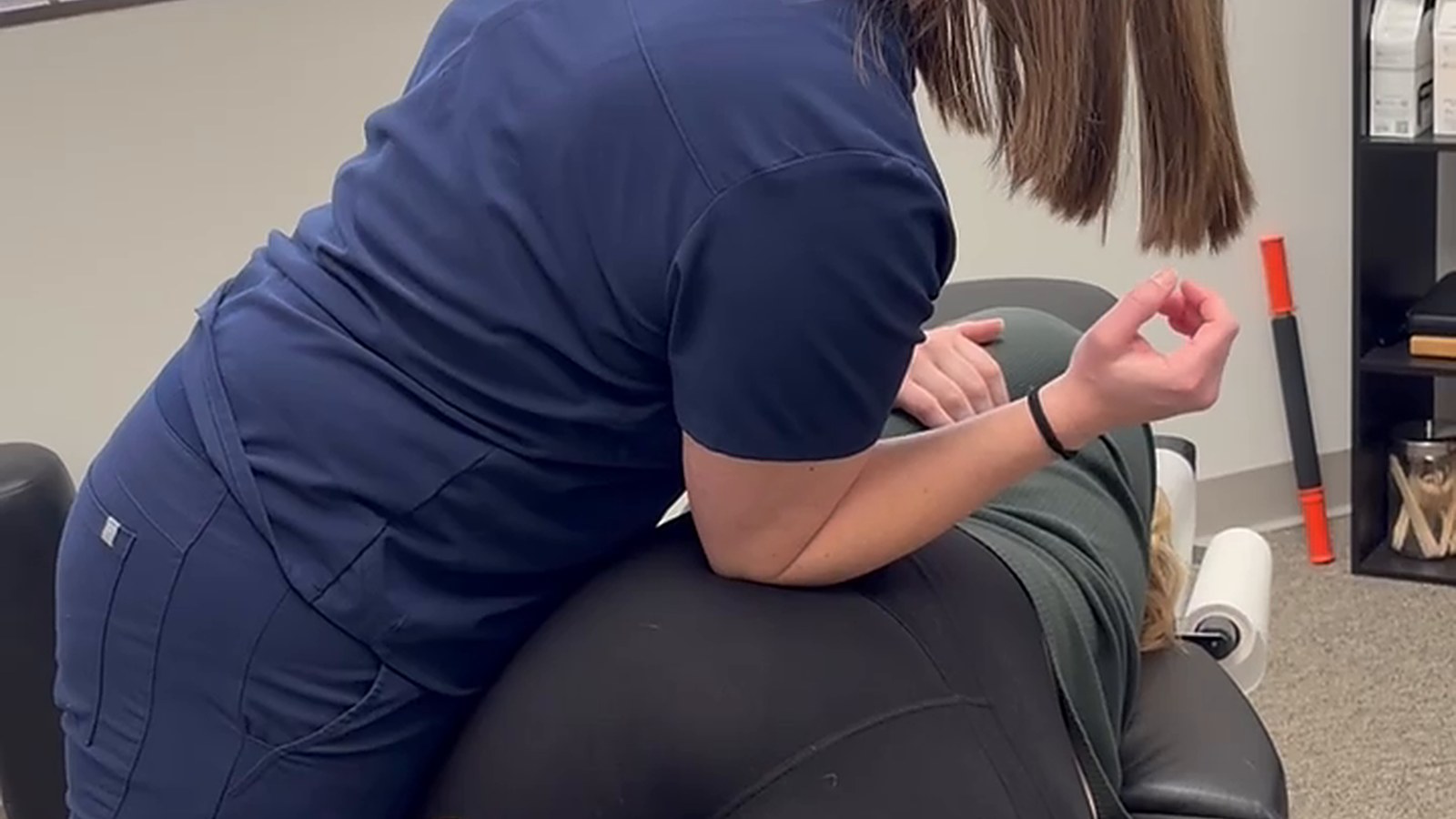
At your New Patient Discovery Assessment in Lombard, we test how your low back and hips move, check reflexes and strength in your legs, and look at what loads the area day to day. If your findings fit a problem we can care for, your plan may include adjustments chosen for you, rehab to build hip and core stability, and a short list of stretches that match your cause. If your findings do not fit, we refer you out.
For the full picture, read about sciatica treatment in Lombard. Not sure whether it is the nerve root or the hip? See sciatica vs piriformis syndrome. If a disc is the suspect, read whether a herniated disc can heal on its own.
When to see a doctor right away
Go to the emergency room if you have numbness in the groin or inner thighs, new trouble controlling your bladder or bowels, or leg weakness that keeps getting worse. Those can signal cauda equina syndrome, which needs urgent care. Also get checked promptly for severe pain that no position eases, fever with back pain, or pain after a fall or accident.
Frequently asked questions
What is the best stretch for sciatica?
There is no single best one, because it depends on the cause. A single knee to chest and a lying figure-four are the gentlest starting points for most people. Stop any stretch that sends pain further down the leg.
Is stretching good for sciatica?
Gentle stretching often helps, and complete rest usually does not. Deep or forced stretches can irritate the nerve, so slow and pain-free is the rule. If stretching makes things worse, get an exam before trying more.
What should you not do with sciatica?
Avoid long stretches of sitting, heavy lifting, twisting under load, and high-impact activity during a flare. Skip toe touches, aggressive hamstring pulls, and deep backbends until you know the cause. Walking in short, easy bouts usually beats bed rest.
How long should you hold a sciatica stretch?
Most gentle stretches are held 10 to 30 seconds, with a few repeats. Movements like cat-cow are not held at all. Shorter and gentler is better than longer and harder when the nerve is irritated.
Can a chiropractor help with sciatica?
A chiropractor can assess whether your pain comes from your spine, your hip, or both, and build a plan around how you move. We refer you out when your findings call for a spine specialist or imaging.
Leg pain that stretching does not fix? Book your New Patient Discovery Assessment and we will find out what is actually going on.
Last updated October 29, 2026 · Dr. Amanda Myers, DC, MS · True Health Chiropractic & Acupuncture, Lombard, IL
One Response