
By Dr. Amanda Myers, DC, MS · Last updated September 17, 2026
There is a burning, pinching pain somewhere between your neck and your shoulder blades, and the internet keeps giving you the same two answers: pinched nerve in the neck, or pinched nerve in the upper back. Which one is it? The difference matters more than most people think — because the two problems behave differently, and one of them is far more common than the other.
Pinched nerve in neck vs upper back comes down to where symptoms travel: a pinched nerve in the neck sends pain, tingling, or numbness down the shoulder, arm, or hand, and it is common. A true pinched nerve in the upper back wraps around the rib cage in a band and is rare. Pain between the shoulder blades is usually referred from the neck.
Two different problems that get one name
A pinched nerve is pressure. A nearby structure — a restricted joint, a bulging disc, an inflamed muscle — compresses a nerve and irritates it. What that feels like depends entirely on where the pressure is.
Your neck (the cervical spine) is built for motion. It moves thousands of times a day, which is exactly why its discs and joints wear, crowd nerves, and cause trouble. Your upper back (the thoracic spine) is built for stability — every vertebra is anchored to a rib. It moves less, so its nerves get truly pinched far less often. That one anatomy fact explains most of the confusion: the neck causes problems that show up in the upper back.
Pinched nerve in neck vs upper back: the comparison
Here is how a pinched nerve in the neck vs upper back actually compares, symptom by symptom:
| Pinched nerve in the neck | Pinched nerve in the upper back | |
|---|---|---|
| Where it starts | One side of the neck, near the base | Mid-back, at spine level between the shoulder blades |
| Where it travels | Into the shoulder blade, shoulder, arm, hand, or fingers | Around the rib cage in a band, sometimes toward the chest |
| What it feels like | Burning, electric, pins-and-needles; numb patches in the arm or hand; grip weakness | Sharp, wrapping pain; tingling that follows one rib level |
| What aggravates it | Looking up, turning the head, coughing or sneezing | Twisting the torso, deep breaths, slouched sitting |
| How common | Common — the C5–C7 nerves are pinched most | Rare — the rib cage keeps the thoracic spine stable |
| Often mistaken for | A shoulder problem or carpal tunnel | A muscle knot, a rib joint problem, or a heart or lung issue |
The single most useful tell is the arm. Nerves that exit the neck run into the arm and hand, so tingling, numbness, or weakness anywhere below the shoulder points to the neck — even when the neck itself barely hurts. The medical name for that pattern is cervical radiculopathy. Thoracic nerves run around the ribs, not down the arm. Pain that wraps like a band at one rib level is the upper back’s signature, and it is uncommon.
The pain between your shoulder blades is usually not pinched there
This is the part most people get wrong. That deep, nagging ache along the inside edge of your shoulder blade? In our Lombard office it is one of the most common complaints we see — and the source is usually the lower neck, not the spot that hurts. The nerves that exit at C5 through T1 refer pain directly into the shoulder blade region. Irritate one of them, and your upper back aches while the actual problem sits four inches higher.
Your body is compensating, too. When a lower-neck joint stops moving well, the muscles between the shoulder blades work overtime to stabilize what the neck will not. They knot, they burn, and they get blamed. Massage feels good for a day, then the ache returns — because the pressure upstream never changed. There is a reason this keeps coming back.
How to tell which one you have
The pinched nerve in neck vs upper back question usually settles with three checks. First: does anything travel below the shoulder — tingling, numbness, or weakness in the arm, hand, or fingers? That is a neck pattern. Second: does the pain wrap around your ribs in a band, or change when you twist or breathe deeply? That points thoracic. Third: does the pain stay in one spot, feel sore when you press it, and ease as you move around? That is usually muscle or joint irritation, not a pinched nerve at all.
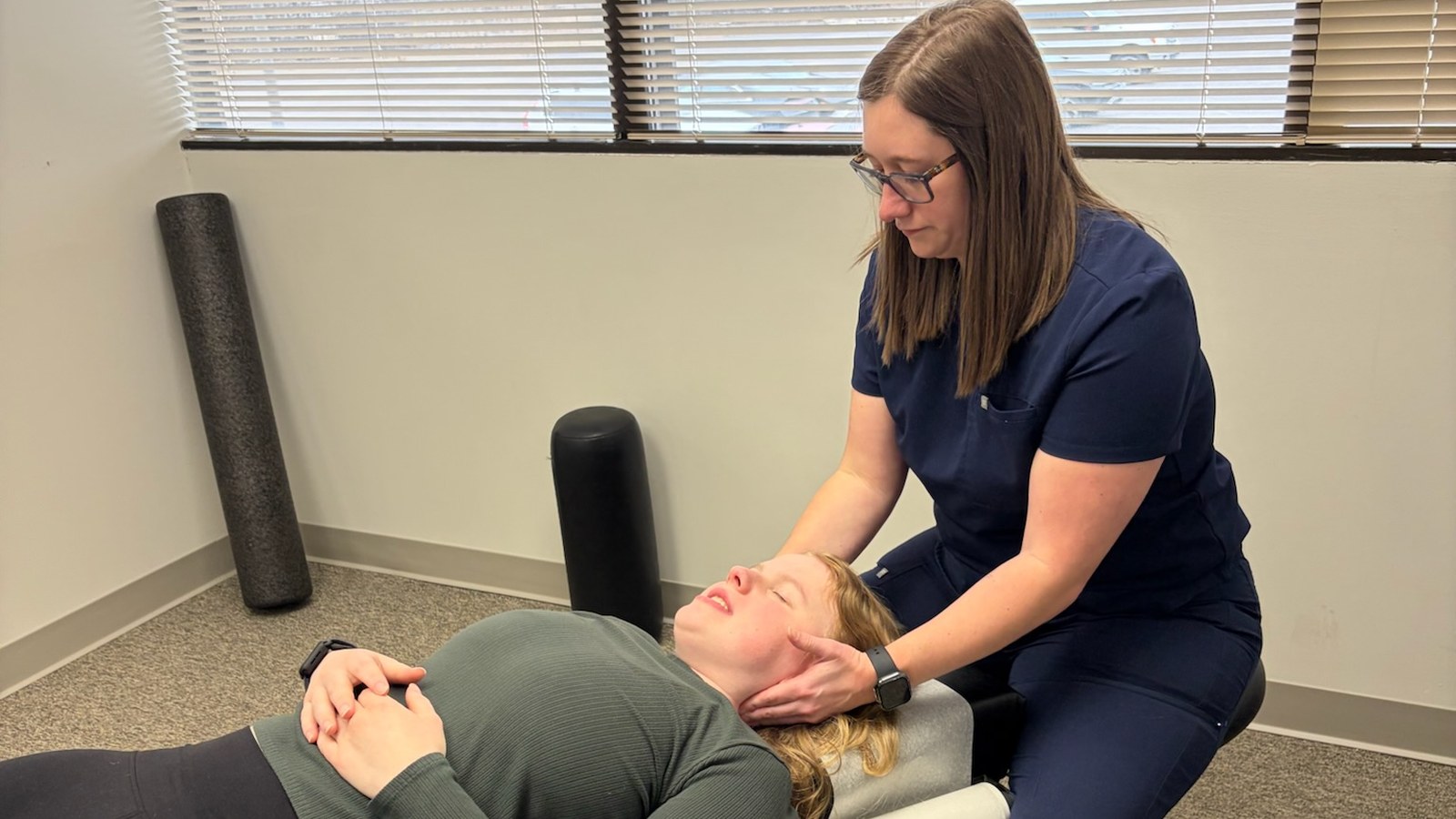
Self-checks narrow it down; they do not settle it. An exam does — movement testing, orthopedic and neurological checks that trace exactly which nerve is irritated and where. That is what we do at every chiropractic assessment at True Health: find the level creating the pressure instead of chasing the spot that hurts.
What actually fixes it
Treating the cause depends on the source. Adjustments restore motion to the neck or mid-back joints that are crowding the nerve. Spinal decompression takes pressure off disc-related compression in the neck. Rehab rebuilds the posture and movement patterns — usually the forward-head, rounded-shoulder pattern — that created the crowding in the first place, so the fix holds. Our neck pain care page walks through what that looks like visit by visit.
Timelines are honest ones: mild cases settle in 2 to 6 weeks, disc-driven cases typically need 6 to 12 weeks of active care. If you are wondering whether yours will settle without treatment, we wrote a straight answer on that here: can a pinched nerve heal on its own.
A few symptoms should skip the wait-and-see entirely. Chest pain or pressure with shortness of breath, sweating, or nausea is not a spine question — get medical care the same day. The same goes for worsening arm weakness, numbness in the groin, or loss of bladder or bowel control. For everything short of that, an exam with a provider who evaluates nerve compression daily is the right next step, and we refer out whenever a case needs more than conservative care.
Pinched nerve questions, answered straight
Can a pinched nerve in the neck cause pain between the shoulder blades?
Yes — this is one of the most common referral patterns we see. The lower cervical nerves send pain directly into the shoulder blade region, so the neck is often the real source of upper back pain. If the ache comes with any arm tingling or numbness, the neck is the first place to look.
What does a pinched nerve in the upper back feel like?
Sharp or burning pain near the spine that wraps around the rib cage in a band, sometimes with tingling along one rib level. Twisting and deep breaths tend to aggravate it. True thoracic pinched nerves are rare — most upper back pain is joint, muscle, or referred from the neck.
How do I know if it is a pinched nerve or a pulled muscle?
A pinched nerve travels — it tingles, burns, or numbs along a path, and it does not care how much you stretch. A pulled muscle stays local, feels sore when you press on it, and generally improves over days with movement. If symptoms run past the shoulder or wrap the ribs, think nerve.
How do you fix a pinched nerve in the upper back?
First find the actual source — a thoracic joint, a rib joint, or a lower-neck problem referring downward. Care then targets it: adjustments to restore joint motion, decompression when a disc is involved, and rehab to correct the posture pattern that built the pressure. Mild cases resolve in 2 to 6 weeks.
When should I worry about a pinched nerve?
Get checked promptly if you have weakness that is getting worse, numbness that is spreading, or symptoms lasting beyond two to three weeks without steady improvement. Chest pain with shortness of breath, or any change in bladder or bowel control, deserves same-day medical care — not a chiropractic visit.
Stop guessing which one it is. Find out what is actually pressing on that nerve — Book your New Patient Discovery Assessment and let’s get to the root of this.