
Last updated: August 6, 2026 | Author: Dr. Amanda Myers, DC, MS
Massage therapy at True Health isn’t a stand-alone relaxation service. It releases the soft tissue restriction that builds up around joint dysfunction, so chiropractic adjustments hold longer and rehabilitation moves faster. Used as part of your root-cause care plan, massage addresses what mechanical correction alone can’t reach.
Why Joint Correction Alone Doesn’t Always Hold
You leave your adjustment feeling loose. A few days later the tightness is back in the same spot. That is not a failed adjustment. It usually means the soft tissue around the joint never let go in the first place.
A joint that has been restricted for months does not just lose motion. The muscles and fascia around it tighten to protect it. Your body learns to guard. When we restore the joint’s movement with an adjustment, that guarding pattern does not disappear on its own. The tissue keeps pulling the joint back toward the position it is used to.
This is why some patients feel great right after an adjustment and stiffer again within a week. The joint moved. The tissue around it did not. Massage therapy addresses that second piece directly, which is why it belongs in a root-cause care plan rather than standing apart from it.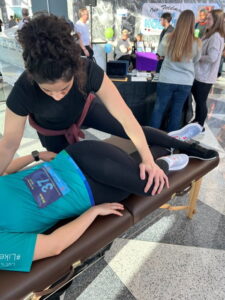
What Massage Therapy Actually Changes
Therapeutic massage works on the muscle, fascia, and connective tissue that hold tension patterns in place. Techniques like deep tissue work, myofascial release, and trigger point therapy break up restriction, improve local circulation, and reduce the guarding that keeps a joint from staying corrected.
This is not the same as a relaxation massage. The goal is not to feel good for an afternoon. The goal is to change how the tissue behaves so the rest of your plan holds between visits.
Where Massage Fits in Your Root-Cause Care Plan
We do not add massage to every plan automatically. It earns a place when your assessment shows soft tissue restriction contributing to your pain or slowing your progress. Here is how it typically fits alongside the rest of your care:
| Phase of Care | Role Massage Plays |
|---|---|
| Early phase, high guarding | Loosens protective tension so adjustments and daily movement are more comfortable |
| Active correction phase | Releases the soft tissue holding a joint in its old position so adjustments hold longer between visits |
| Rehabilitation phase | Clears restriction that limits the range of motion needed for strength and movement retraining |
| Maintenance | Used periodically for athletes, high-stress patients, or chronic tension patterns |
Your assessment determines whether massage belongs in your plan, and how often. Some patients need it weekly for a short stretch. Others use it every few weeks as ongoing maintenance.
What Massage Therapy Does Not Do
Massage will not correct a joint that has lost its normal motion. It will not rebuild strength lost after months of favoring an injury. It will not fix the movement pattern that caused the overload in the first place.
We are direct about this with patients: massage changes the tissue environment. It does not replace chiropractic correction or rehabilitation. Used alone, it tends to give relief that fades within days. Used alongside the rest of your plan, the relief holds.
What a Combined Visit Looks Like
Many patients receive massage in the same visit as their chiropractic adjustment, timed so the tissue work happens before or after the correction depending on what your body needs. A typical session runs thirty to sixty minutes depending on how much area needs attention.
You do not need a separate diagnosis to explore whether massage belongs in your root-cause care plan. It comes up naturally during your massage therapy evaluation as part of your broader assessment at True Health.
Frequently Asked Questions
Can massage therapy replace chiropractic adjustments?
No. Massage addresses soft tissue restriction. It does not restore joint motion or correct the mechanical cause of your pain. At True Health, we use it alongside chiropractic and rehabilitation, not in place of them, so the root cause still gets addressed as part of your root-cause care plan.
How many massage sessions will I need?
It depends on what we are addressing. Acute tension patterns often respond to a few weekly sessions. Chronic restriction or ongoing athletic recovery typically works best every two to four weeks. Your assessment determines the right frequency for your case.
Is massage therapy going to be uncomfortable?
Deeper tissue work can be uncomfortable in tight areas, similar to the feeling of stretching a tense muscle. We adjust pressure to what you can tolerate and want your feedback throughout. Mild soreness for a day or two afterward is normal.
If tightness keeps returning to the same spot after your adjustments, or your rehabilitation feels stuck, massage may belong in your root-cause care plan. Only your assessment can tell us that for certain. Book Your New Patient Discovery Assessment